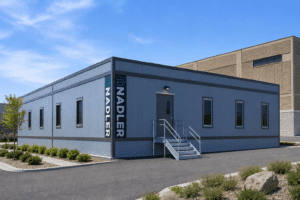
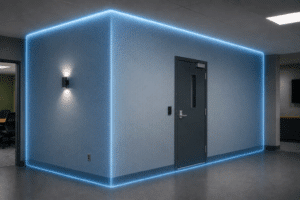
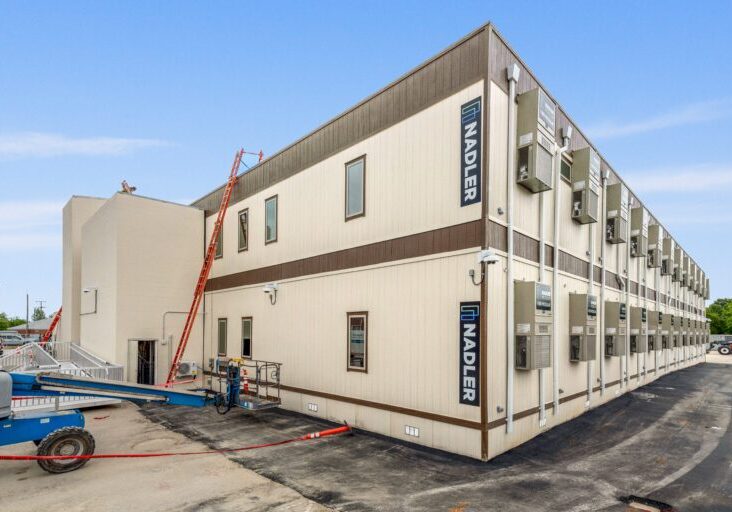
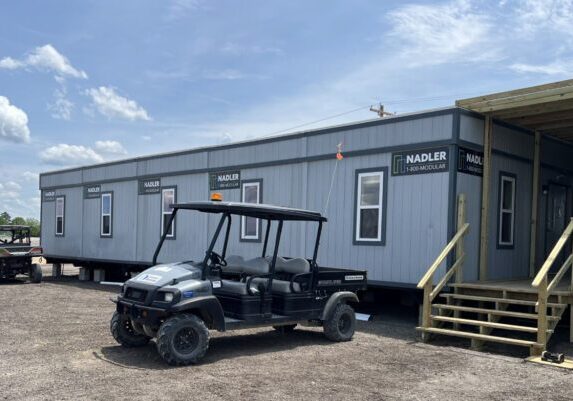
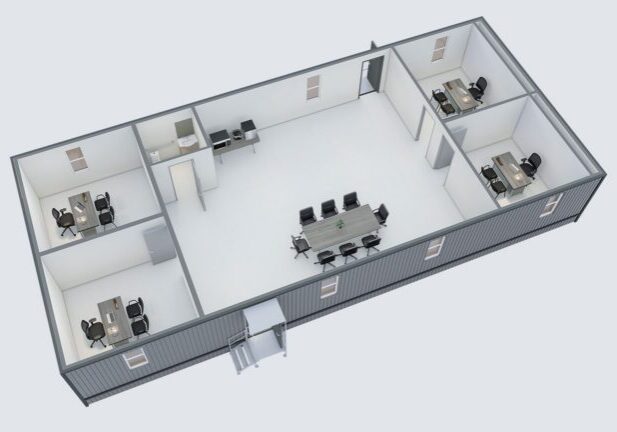
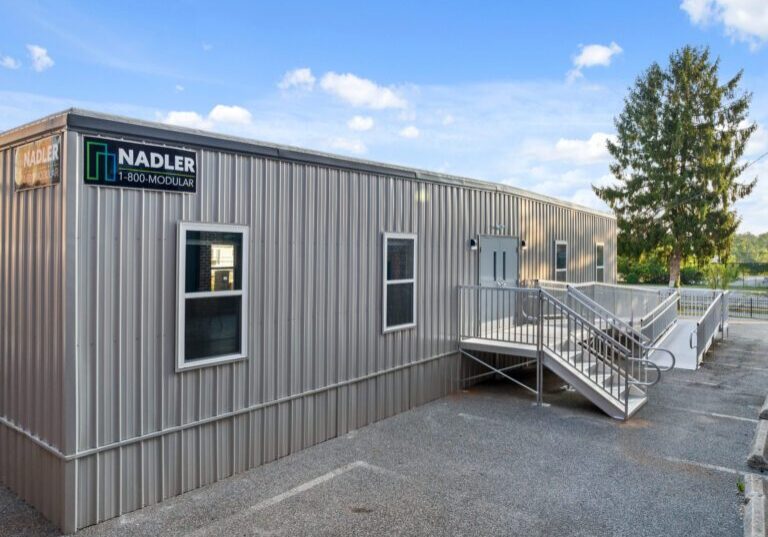
A modular SCIF is a Sensitive Compartmented Information Facility built in a controlled factory and assembled on site — held to the same ICD 705 security standards as any fixed SCIF, just delivered faster. Here's how modular SCIF construction works and how federal buyers procure one.
With 12 years of experience in the modular industry, Brandon focuses on business development, estimation, and project management. He specializes in government design-build projects that have turnkey scope requirements. Currently, he is responsible for business development for major design-build projects at Nadler.
Written by:Brandon Powelson (Territory Sales Manager, Military & Defense) Reviewed by:Scott Bender, PE (Construction Services Manager) Last updated: May 2026 · Next review: November 2026
A modular SCIF is a Sensitive Compartmented Information Facility: a secure, accredited space for handling classified information, delivered as a prefabricated building rather than stick-built on site. It’s governed by Intelligence Community Directive 705 and built to the same physical, acoustic, and electromagnetic standards as any fixed SCIF. Nadler Modular designs and delivers ICD 705-compliant modular SCIFs for the US military, federal agencies, and cleared defense contractors, with over four decades of modular construction experience and a published record of federal and military projects.
What is a modular SCIF?
A Sensitive Compartmented Information Facility (SCIF, pronounced “skiff”) is an accredited secure space where Sensitive Compartmented Information can be stored, discussed, and electronically processed. SCIFs are used by the military, the intelligence community, federal agencies, and cleared defense contractors. Access requires a security clearance and being “read in” to the specific program operating inside.
A modular SCIF is a SCIF built to the same standards as any other — but prefabricated in a controlled manufacturing facility and assembled on site. The classification and accreditation requirements are identical. What’s different is how the building arrives.
Federal agencies: Department of Defense components, intelligence agencies, and civilian agencies handling classified information
Cleared defense contractors: secure workspaces required by their classified contracts
Embassies and diplomatic facilities: secure communication spaces abroad
When modular makes sense versus fixed construction
Modular SCIFs aren’t always the right call. They tend to be the better option when:
Schedule matters — a Nadler modular SCIF typically runs 8–12 months from first conversation to accreditation-ready, compared to 12–24 months for stick-built
The facility may need to move later — modular units can be disassembled and redeployed without losing compliance
The host base wants to minimize on-site disruption and cleared-construction burden
Budget predictability is a priority — most of the build happens in a controlled environment with fewer variable cost drivers
Fixed construction is usually the better choice when the SCIF is part of a large permanent facility, when custom architectural integration is required, or when the classified operations will absolutely never move. We build both; this page is about the modular option.
Standards we build to: the ICD 705 document stack
Every compliant SCIF must meet a specific set of federal standards. The document stack builds on itself:
ICD 705 (Intelligence Community Directive 705)
The capstone directive governing SCIF construction and accreditation, issued by the Director of National Intelligence. ICD 705 sets the baseline: what a SCIF is, what it has to do, and how it gets accredited. It’s the document that anyone discussing SCIF compliance must start with.
ICS 705-1 (Intelligence Community Standard 705-1)
The specific physical and technical security standards that sit under ICD 705. ICS 705-1 defines the minimum requirements for perimeter security, acoustic performance, RF shielding, and other physical controls.
IC Tech Spec for ICD/ICS 705, version 1.5.1
The detailed implementing specification — essentially the “how to build it” document. The current IC Tech Spec, version 1.5.1, was released in July 2021. Nadler builds to this specification.
UFC 4-010-05 (Unified Facilities Criteria)
The Department of Defense’s implementation of ICD 705 standards for DoD construction projects. If the SCIF is being built for a DoD facility, UFC 4-010-05 applies in addition to ICD 705.
Related standards
SAPF (Special Access Program Facility): Similar to a SCIF but for Special Access Programs. Different accrediting authority, often overlapping construction requirements.
TEMPEST: Standards for RF and electromagnetic emissions shielding. Applied when the SCIF’s electronic processing or its location warrants it, at the direction of a Certified TEMPEST Technical Authority (CTTA).
UL-2050: Underwriters Laboratories standard for intrusion detection systems used in high-security applications, including SCIFs.
DoDM 5105.21 (Volumes 1–3): The DoD administrative security manual that governs SCIF accreditation waivers and administrative processes.
For a deeper walkthrough of the standards stack and the specific physical, acoustic, and shielding requirements, see our Full ICD 705 requirements guide.
ICD 705 recognizes several SCIF categories based on how they’re built and where they’re deployed. Understanding the types helps federal buyers scope the right solution.
Fixed / conventional SCIFs
A stick-built construction, assembled into a permanent building, typically on a military base or in a federal facility. Longest schedule, highest on-site burden, and maximum integration into the host architecture.
Does Nadler deliver?No. Fixed stick-built SCIFs are outside our scope. We focus on modular delivery.
Modular SCIFs
Prefabricated SCIFs manufactured in a controlled facility and assembled on-site. The sweet spot for schedule, relocatability, and controlled-construction security. This is the primary focus of this page. For non-secure permanent applications, see our permanent modular buildings.
Does Nadler deliver?Yes. Modular SCIF construction is our specialty, and the type we deliver.
Container SCIFs
Built inside modified 20-foot or 40-foot ISO shipping containers. Highly portable: can be trucked, shipped by C-130 / C-17 aircraft, or moved by sea. Smaller footprint, ideal for tactical or expeditionary use.
Does Nadler deliver?No. While Nadler does offer shipping container office conversions, SCIF-grade container work is outside our current scope.
Mobile / Tactical SCIFs (T-SCIFs)
Deployable units for field operations — purpose-built trailers, transportable shelters, or truck-mounted units. Used for exercises, forward deployments, and operations where mobility is non-negotiable.
Does Nadler deliver?No. T-SCIF is a specialist niche we don’t currently serve. However, we can refer project teams to appropriate specialists.
Nadler’s SCIF scope — confirmed: Nadler delivers modular SCIFs. We do not offer fixed, container, or tactical SCIFs. We’re happy to refer buyers with needs outside our scope to appropriate specialists. This page covers all four types for completeness and topical authority, but our capability claims are limited to modular SCIFs only.
Physical and technical requirements
A compliant SCIF must meet six security requirements at the same time. Every modular SCIF Nadler builds meets all six.
Physical security — perimeter, walls, access control
Perimeter walls, ceilings, and floors built to resist forced entry. Intrusion detection systems (IDS) covering every penetration. GSA-approved access control hardware. Standard minimum: five minutes of forced-entry protection.
Acoustic security — STC 45 / STC 50
Sound Transmission Class (STC) ratings govern how much speech or amplified sound escapes the facility. ICD 705 generally requires STC 45 for normal conversation, and STC 50 when amplified audio or video teleconferencing is used inside the space. Nadler’s modular SCIFs are built to the STC 50–55 range, meeting and frequently exceeding both baseline requirements based on the wall assembly and project specifications. Final acoustic performance is confirmed against project-specific requirements during design.
RF / TEMPEST shielding
When the SCIF’s operations or location require it, at the direction of a Certified TEMPEST Technical Authority, the facility must shield against RF emissions and external RF interference. Shielding is generally specified in decibels (dB) of attenuation across a given frequency range.
60 dB RF attenuation is a common SCIF baseline. NSA 94-106 defines the higher-performance shielded-enclosure spec that can require up to ~100 dB attenuation in demanding TEMPEST applications. Final attenuation requirements are set by the CTTA on a per-project basis. Nadler’s modular SCIFs are engineered to meet the attenuation level the CTTA specifies for each project.
Mechanical and electrical isolation
HVAC, plumbing, and electrical systems must be designed to prevent compromising emanations and acoustic leakage. Penetrations through the SCIF perimeter are tightly controlled. In practice, this means dedicated systems, sealed conduit paths, and careful routing, all planned during the modular design phase rather than retrofitted later.
Construction security during the build itself
This is where modular has a significant advantage. A compliant SCIF build requires a Construction Security Plan (CSP), cleared personnel, screened materials at a Secure Storage Area (SSA), and often Construction Surveillance Technicians on site. When most of the build happens in a controlled factory environment, much of that burden disappears.
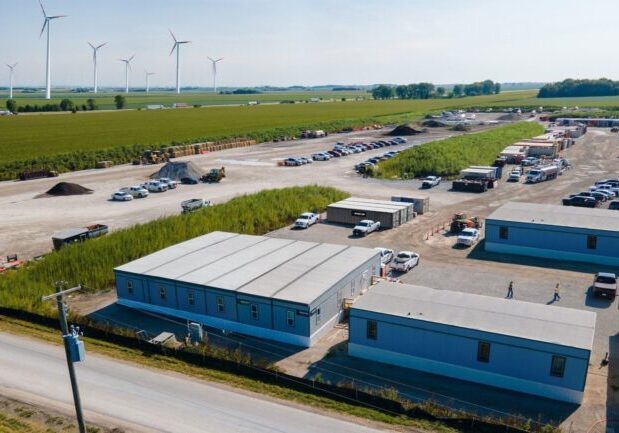
For Nadler’s modular SCIFs, the bulk of fabrication happens in our modular manufacturing facility, where access controls, material screening, and construction oversight can be maintained under controlled conditions. On-site assembly exposure is minimized, which reduces cost, schedule risk, and the cleared-construction load on the host facility.
Fire code and ADA compliance
Every SCIF must also comply with applicable fire and life-safety codes (typically NFPA 1 and NFPA 101) and federal accessibility requirements (ADA or UFAS, depending on jurisdiction). For DoD SCIFs, these flow down through UFC 1-200-01 and are not optional.
Why modular makes sense for SCIFs
Schedule: faster and more predictable than stick-built
Traditional stick-built SCIF construction typically runs 12–24 months from ground-break to accreditation, with cleared construction on a live base adding variability at every stage. Nadler’s typical modular SCIF project runs 8–12 months from the first scoping conversation to accreditation-ready delivery, with the exact timeline depending on project scope, mission requirements, and the accrediting official’s inspection schedule. Most of that time is productive design, cleared manufacturing, and coordination, not waiting for on-site trades.
Cleared construction in a controlled facility
Every material, every person, every inspection happens inside a manufacturing environment we control. That’s fundamentally different from a base construction site where third parties, weather, and uncontrolled access all create compliance risk.
Relocatability
A modular SCIF can be disassembled and redeployed at a new location without losing compliance, provided the chain of custody is maintained, and the new site is re-accredited. For contingency operations and base realignments, this kind of flexibility is worth significant capital.
Reduced disruption to ongoing base operations
Modular assembly is measured in days to weeks of on-site activity, not months of trades traffic. For an active installation, that is the difference between “manageable” and “this quarter’s project has been deferred.”
How federal buyers procure a Nadler SCIF
GSA Schedule 56 — Contract #47QSMS24D00AF
Nadler is a GSA Multiple Award Schedule contract holder under Schedule 56 (Buildings and Building Materials / Industrial Services and Supplies). Our GSA Schedule 56 program covers prefabricated and pre-engineered buildings, including lease, rental, installation, and site preparation. For federal buyers, that means pre-negotiated pricing, a streamlined ordering process, and FAR-compliant procurement without a full open competition for every transaction.
The SINs that cover Nadler’s SCIF work under our current MAS:
SIN 361-10E — SCIF purchase
SIN 361-50E — SCIF lease
Both pathways are available depending on whether the program wants to own the facility outright or lease it over an operational window. Our Military & Defense team is available to confirm which pathway fits a specific project and coordinate the GSA ordering mechanics end-to-end.
TIPS Contract 230902 for permanent buildings
Nadler also holds TIPS Cooperative Purchasing Contract 230902 in the Permanent Modular Buildings category. TIPS is a cooperative vehicle used by schools, governments, and public agencies to buy without running a separate bid process — useful on state, local, and federal projects where TIPS is accepted.
Direct purchase on major projects (Government Field Office pathway)
On major federal projects, a Government Field Office or similar supporting structure can generally be procured directly as part of the project scope, rather than through a separate facilities acquisition. If your project falls in that category, we can work with your contracting officer to confirm the pathway.
Working with our Military & Defense team
Brandon Powelson leads our military and defense solutions and is the primary contact for federal SCIF projects. When you submit a quote request through this page, it’s routed directly to Brandon and his team, who coordinate every aspect of the project — scoping, GSA procurement mechanics, design, and delivery, with support from Nadler’s GSA Specialist where the contract pathway requires it.
Project timeline — what to expect
A typical Nadler modular SCIF project moves through these phases:
Phase
Typical Duration
What Happens
Discovery & requirements
Within 8–12 month cycle
Intent, site conditions, classification level, STC/RF requirements, AO identification
Design & engineering
Within 8–12 month cycle
Building design, Construction Security Plan development, compliance documentation prep
Accreditation planning
Parallel with design
Coordination with Accrediting Official (AO), CSP approval
Manufacturing
Within 8–12 month cycle
Fabrication in a controlled facility with cleared materials and personnel
Final walkthrough and preparation for AO inspection
Accreditation
Governed by the AO’s schedule
Formal AO inspection and accreditation decision
Total cycle: Nadler’s modular SCIF projects typically run 8–12 months from the first scoping conversation to the accreditation-ready delivery. Phase-level durations depend primarily on project scope, classification level, design complexity, and the Accrediting Official’s schedule. Phases marked as parallel run simultaneously where the CSP and program requirements allow.
San Juan VA Medical Center: 25 modular units for the Veterans Administration in Puerto Rico, designed for tropical environment longevity
Amtrak Philadelphia redevelopment: site office support for a major federal infrastructure project
At Nadler, we’ve successfully delivered modular SCIF projects for federal and defense clients. Because of the classified nature of this work, project details — including base names, floor plans, end users, and mission scope — are not published. References can be provided upon authorized request through appropriate government channels.
Relevant credentials
GSA Schedule 56 Contract Holder: #47QSMS24D00AF (30+ years as an approved GSA vendor). SINs covering SCIF work: 361-10E (purchase) and 361-50E (lease).
TIPS Contract 230902: Permanent Modular Buildings
New York Minority-Owned Business: relevant for federal supplier diversity requirements
Modular Building Institute (MBI) Awards of Distinction: every year since the company’s inception
EMR (Experience Modification Rating) of 0.85: better than industry average, a concrete safety benchmark used in federal prequalification
American Institute of Architects (AIA) recognition for standout projects
Sensitive Compartmented Information Facility. Accredited secure space for classified information.
SAPF
Special Access Program Facility. Similar to a SCIF but for Special Access Programs.
SCI
Sensitive Compartmented Information. The classification category handled inside SCIFs.
ICD 705
Intelligence Community Directive 705. The capstone standard governing SCIF construction and accreditation.
ICS 705-1
Intelligence Community Standard 705-1. Specific physical and technical security standards under ICD 705.
IC Tech Spec
IC Technical Specification for ICD/ICS 705. The detailed implementing specification (current version 1.5.1, July 2021).
UFC 4-010-05
DoD Unified Facilities Criteria 4-010-05. DoD’s implementation of ICD 705 requirements.
AO
Accrediting Official. The authority that inspects and accredits a SCIF for operational use.
CSA
Cognizant Security Agency. The agency responsible for a given SCIF program.
CSP
Construction Security Plan. The required plan governing personnel, materials, and site security during the build.
CTTA
Certified TEMPEST Technical Authority. The specialist who directs RF shielding requirements.
DoDM 5105.21
DoD Manual 5105.21 (Volumes 1–3). The administrative security manual for SCIF accreditation.
STC
Sound Transmission Class. Acoustic performance rating for SCIF walls. Typical minimums: STC 45 for conversation, STC 50 for amplified audio.
TEMPEST
Codename for standards governing RF / electromagnetic emissions security. Applied when classified operations warrant it.
T-SCIF
Tactical SCIF. A deployable SCIF variant for field and expeditionary use.
UL-2050
Underwriters Laboratories standard for high-security intrusion detection systems.
SSA
Secure Storage Area. The space where SCIF materials and equipment are held and screened before installation.
Ready to start your SCIF project?
Nadler Modular has been delivering modular buildings for federal and military clients since 1977. If your project requires an ICD 705-compliant SCIF, or you’re still deciding whether modular is the right approach, let’s talk.

 ChatGPT